
Isabel Nuñez traveled the world, advancing her education and applying her knowledge to professional pursuits.
She tells her story to young people affiliated with Latinos Count at Positive Pathways events and encourages students to consider learning beyond high school as one route to a good life.
“I don’t think doing well in school means you’re smarter than anyone else or you’re a better person, but I do know it gives you more options,” she says. “I think the (Pathways) event is about providing lots of different examples of pathways. Mine would be an example of a pathway.”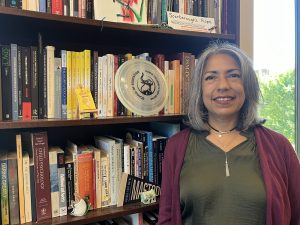
Nuñez, professor and dean of the school of education at Purdue University Fort Wayne, was born in Los Angeles to parents of Mexican descent and graduated high school at 15. She earned her bachelor’s degree in English from the University of Southern California, a law degree from UCLA and a master’s in cultural studies from Birmingham University in England.
She says she wanted to change the world through the law, but decided that education was a better way toward that goal. So, she got her Ph.D. in curriculum studies from the University of Illinois-Chicago. Her thesis was on curriculum integration.
She attributes a quote to renowned educator Arthur Levine regarding the value of schools in society: “Education may be the slowest means to social change but it is the only means.”
And, she notes, the more education one has the better their lifetime earnings. Data supports it.
Along the way in her educational journey, Nuñez has taught first graders, was an editor for the English version of the Mainichi newspaper in Japan, and was a professor at two universities. She is also a published author.
She enjoys listening to students’ ambitions for their own futures during the Latinos Count events: “So many of them have exciting ideas about what to pursue. One young woman in particular stood out because of her desire to spend time living abroad. She said her mother told her that she should live for an extended time in a poor country, and for another stretch of time in a global city. I was impressed by that mother's wisdom.”
The young women’s account sounds like she’ll be following a similar path to the one taken by Nuñez. And by Nuñez’s daughter, who is a high school junior and will be spending next year as an exchange student in Japan.
“I try to be very careful in not assigning a moral value (to education),” Nuñez says. “College may not be for everyone. But I want young people to make as informed a choice as possible. I tell my story to inspire them. To demonstrate the possibilities. To leave as many options open for them as possible.”
For Nuñez, the education option has made all the difference in the world.