In 2016, Sofia Rosales-Scatena was nearly killed when her squad car was hit by another vehicle. In 2017, after a nearly year-long recovery, she and her husband were in the final stages of adopting two children when her husband died of a heart attack.
The 54-year-old captain with the Fort Wayne Police Department knows what it takes to persevere through the hard times. She passes the wisdom of resiliency along to the young people associated with Latinos Count.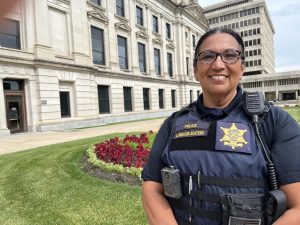
“There are things that will happen to you in this life and you have to find your way back,” she says. She noted that she carried through with the adoption as a single mother. “When I have a plan, I like to stick to it. This was our plan. I wasn’t deviating from it.”
Rosales-Scatena, who is president of the Fraternal Order of Police, also talks to young people about choices – the good ones and the bad ones. In her 32 years with the department, she’s seen the devastating outcomes of bad choices.
“You have to talk about what a good relationship looks like, what not being involved in criminality looks like, what not being involved in drugs looks like,” she says.
Poor choices, she says, can be disqualifiers for living a good life and for getting a job. That is especially true for people seeking a job in law enforcement.
“I talk a lot to Latino kids about policing as a career,” Rosales-Scatena says. “It is something that is needed. The police department has to somewhat reflect the communities that it serves. So, I want to encourage them to do this job.”
Cultural norms, she says, keep some Latinos from considering law enforcement as a career. As a Mexican-American, she says, “it’s important for me to be out there” talking about the occupation.
“I don’t think some Latinos understand what the possibilities in this country are,” she says. “I want these kids to see what’s available to them. I want to help open up their world to the opportunities that exist that they may not be aware of. I think it’s especially important for females. We’re still living in a culture that doesn’t necessarily see women in positions like mine.”
She takes her mission as a Latinos Count mentor seriously, in part because she’s benefitted from having someone walk alongside her. She recently spoke at a retirement ceremony for a colleague who bolstered her self-confidence.
“He pushed me,” she says, “and made me better and made me believe in myself when I wasn’t sure I could do something. I admire him so much for what he’s done for me.”
On the whole, she thinks Latinos Count and the Latino community have done a good job of steering kids in the right direction.
But she’s not about to let her guard down.
"Our kids are looking for meaningful connection and authenticity from adults,” she says “It's our job to give that to them. We have to hand them a world we would want to live in. To do that, we have to be invested in them. Latinos Count is how I do that."